Engineered, not generated

GraceZero

We build the software small operations actually run on, measure how it’s really used, and keep making it better. Enterprise standards at agile speed, sized for smaller budgets. Production-grade, and improved on evidence.

The Pedigree. Led by an engineer who specializes in building on Anthropic’s Claude models, with 25+ years building and operating global infrastructure for thousands of users. The same hardened engineering the Fortune 500 pays six figures for, applied to independent operations the big firms won’t quote.

The Delivery. Customer and member portals. Internal operations tools that replace four spreadsheets with one web app. Brochure sites rebuilt as working web apps that install on a phone without an app store. Every one of them instrumented on day one, so you can see what people actually do with it.

The Terms. Direct communication. Fixed quotes. Zero fluff.

GraceZero is a data-driven product studio. We build the software small and mid-sized organizations actually run on: customer and member portals, internal operations tools, and brochure websites rebuilt as working web apps that install on a phone without an app store. Everything ships production-grade, with the monitoring, backups, and security posture a Fortune 500 would demand.

Then we do the part most builders skip. We measure how the software is really used, find where it fails the people using it, and make it measurably better over time.

Most of our work starts with something that already exists. A website that stopped earning its keep, a portal your customers avoid, an app nobody has touched in three years. You don’t have to start over to find out what’s wrong. Here’s how we look at what you already have.

The Ai space is full of builders shipping prototypes and calling them products.

Demos great. Breaks the first week. Nobody answers the phone when it does. It’s different here. Enterprise discipline, without enterprise drag. Scoped before we start. Documented at handoff. Monitored after launch. Decisions made in days, not quarters.

What most builders skip

Most people building with Ai tools today have never operated software in production at real scale. They don’t ask about backups. They don’t plan for failure modes. They’ve never been the person on call at 2am when something breaks for thousands of users. Their work looks great in demos and falls apart under real conditions.

What’s different here

The difference isn’t credentials on a page. It’s the questions that get asked before any code gets written: about failure modes, about documentation, about what happens six months from now when nobody remembers how it was built. That discipline comes from 25+ years of being the person responsible when things went wrong at scale.

For organizations that deserve better

Small businesses, civic organizations, and professional practices have never had access to scoped, documented, monitored, backed-up, recoverable engineering. The firms that do this work well quote six figures for what we scope, build, and walk through end-to-end. Same scope. Fraction of the price. That gap shouldn’t exist, which is why our pricing is published instead of quoted on request.

Built for the long run

Every build comes with full documentation and a live walkthrough. What happens after delivery depends on what you need. Some clients run independently, others keep us on retainer. Either way, we build it to last and we’re not hard to reach.

  for the shop, the practice, the studio, the site.

Five layers on one foundation. Instrument it once.

Most shops sell the first layer and leave. The build is the on-ramp. What makes the software worth keeping is everything that happens after it ships.

  1. Build.The web app itself, or your existing website rebuilt as one. The foundation everything else runs on.
  2. Intelligence.Because “I think it’s going well” isn’t a number. You stop paying for features nobody opens, and you catch the customer drifting away while you can still call them.
  3. Optimize.Ongoing improvements delivered as A/B tests with proof of lift. We don’t guess what to fix, we prove the win.
  4. Engage.Who’s active, who’s slipping, and the automated nudges and win-back that turn drifting users back into active ones.
  5. Care.Managed hosting, monitoring, backups, incident response, SLA. It lives here and we keep it alive.

Build, Intelligence, and Care run today. Optimize and Engage come online once your web app has enough traffic to test against honestly, which is usually a few months in. We’d rather tell you that now than sell you a test that can’t reach significance. The five layers in full.

TackleAgent. A real web app, and the data loop running underneath it.

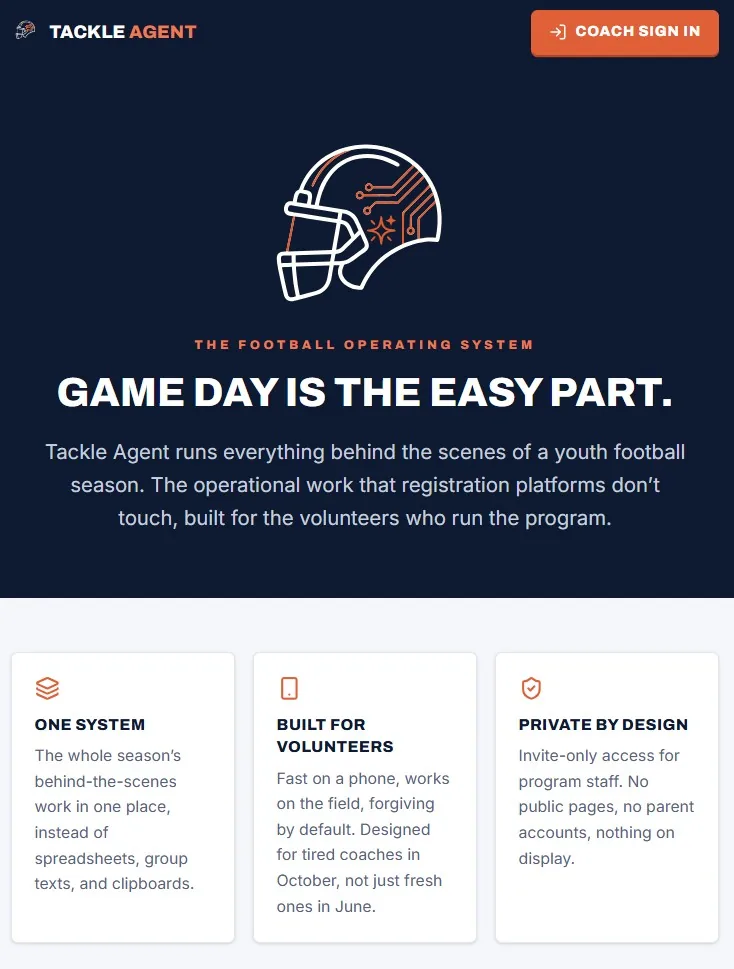
A volunteer-run youth football league was operating on a Facebook group, a parent text chain, and three spreadsheets nobody owned. TackleAgent replaced all of it: 13 operational modules, 80 phone-first screens, an offline outbox so the sideline keeps working when the signal doesn’t, and a full audit trail on every record. It runs the league today at tackleagent.com.

That’s the part every builder shows you. Here’s the part almost nobody does. Because it was instrumented on day one, we ran a usage review in week seven against the live database and the software told us how it was actually being used:

5,988
recorded actions across 54 active users in the first seven weeks
44%
of everything happens between 6pm and 8pm, on the field
248
player equipment day, run on it live
103
automated test specs behind it

None of these are vanity metrics. Each one is an instruction. The 6-to-8pm concentration killed every remaining desktop-first idea on the roadmap. We rebuilt for the sideline, then measured it again.

Most builders skip this part, and the reason is simple: nobody wants a written record of what they got wrong. We keep one. It is the difference between software that ships and software that gets better. We don’t guess what to fix. We measure it, change it, and measure again. The full case study, plus the rest of the work.

sanitized case study · no player names, records, or screenshots of minors’ data appear anywhere on this site

A brochure site is a dead end. It says you exist, then stops.

A web app is your site and a working customer portal in one thing. Members log in, book, pay, submit, check status. And unlike a static site, it produces behavioral data a brochure page never can: who came back, what they tried to do, and where they gave up.

It installs on a phone without the App Store

Your customer taps add to home screen and it’s an icon on their phone like anything else. No App Store review queue, no Google Play review queue, no annual developer fees, no waiting on someone else’s approval to ship a fix. One codebase covers phone, tablet, and desktop, and the field screens keep working when the signal drops.

We don’t build native iOS and Android. On purpose.

Native means two more codebases, two review queues, two release cycles, and two more places your urgent fix sits waiting on a stranger. For the operations we serve that cost buys nothing a web app doesn’t already deliver. You approve it, we ship it, your people have it that afternoon. If a build genuinely needs native, we’ll tell you and point you somewhere good.

The Ai in the name isn’t a chat window bolted to a corner.

Ai isn’t a separate product we sell you. It runs in three places, and each has to earn its keep.

  1. Inside the product, where it removes work.A coach dictates loose notes after a game and the web app turns them into structured records, instead of demanding a form from someone exhausted in week nine.
  2. Reading the product.It turns usage data into a prompt to act, rather than a chart to interpret.
  3. Building the product.Claude does the typing. A human architect decides the data model, draws every security boundary, and signs off on every deploy.

What we deliberately don’t build is a bolt-on help chatbot. A bot answering “how do I do X” is usually a bandage over navigation that already failed. Our own data proved it: the biggest drop-off in TackleAgent sits between finishing a profile and reaching a working module. That’s a navigation problem, not a question problem.

We add Ai where it removes work, and we measure whether it did. Anyone can ship a chatbot. Almost nobody checks whether it helped.

We monitor everything we run. Including this page.

Hopper Ops is our own operations layer, the dashboard we check every morning to know our own work is up: uptime, backup freshness, token spend, model retirements, CVEs. Your build won’t show up on our public view, but it’ll be held to the same standard. Public read-only view here.

/  hopper ops · publicloading
services5 / 5 up
anthropicoperational
modules34 / 34
last refresh-
view dashboard

Let’s find your first win.

Free 45-min strategy call · no obligation · for the shop, the practice, the studio, the site.

get a quote → ]